

Honda Odyssey vs Toyota Sienna: Which Minivan Is Right for You?
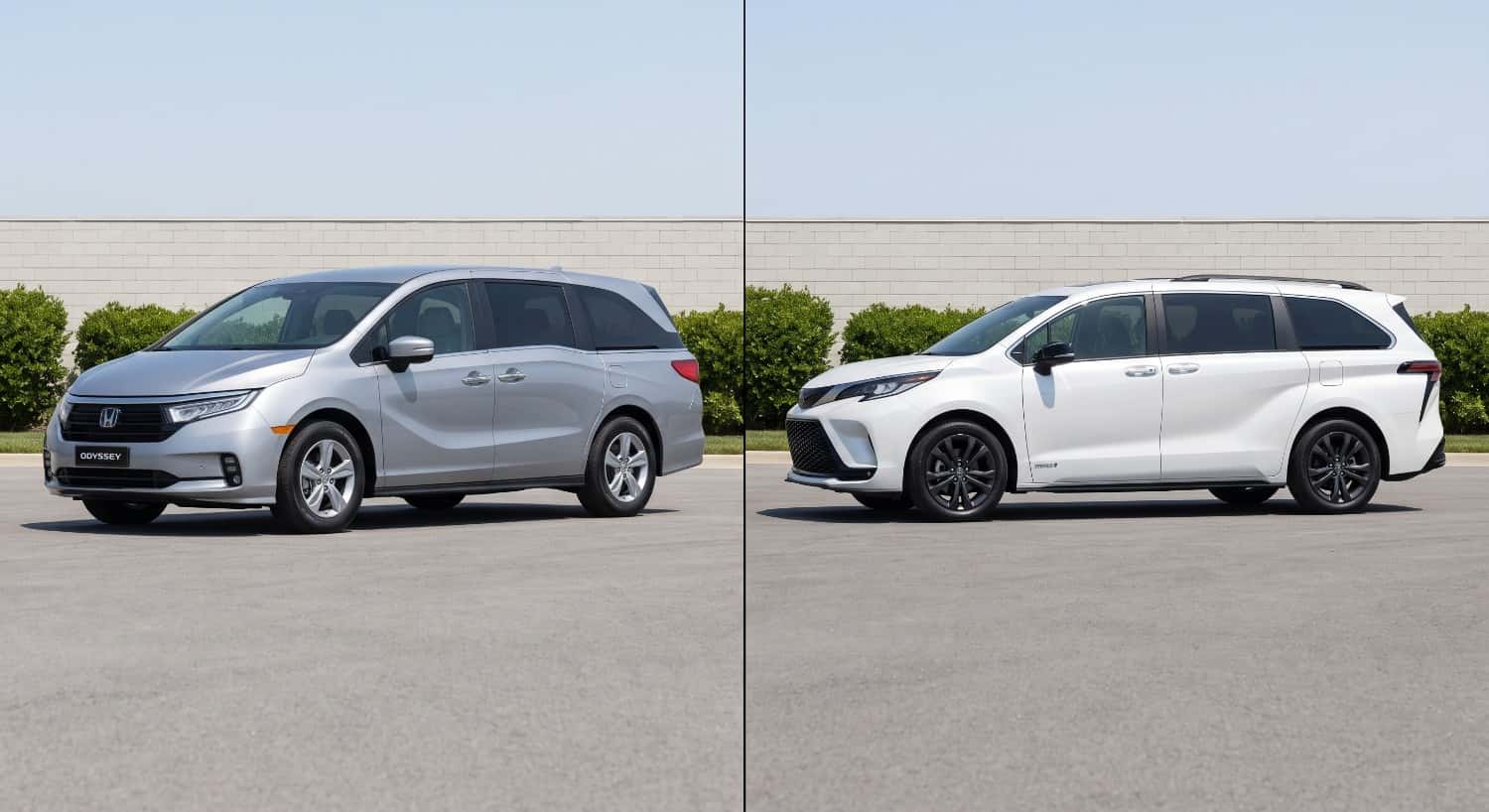
School drop-offs, bulky stroller folded in back, and two toddlers kicking your front seat. That is daily life for most parents visiting us at Hodge Toyota. Choosing between the 2026 Honda Odyssey and the 2026 Toyota Sienna usually comes down to two things: how you drive and how your kids sit. In this honda odyssey vs toyota sienna breakdown, our showroom team looks at official 2026 manufacturer data, real gas mileage, and actual cabin space.
Both haul groceries and sports gear with zero fuss. But they handle your family routine in completely different ways.
By the end of this guide, you will know exactly which minivan fits your daily commute, road trips, and monthly household budget.
Quick Summary: Which Minivan Fits Your Family?
The 2026 Toyota Sienna wins for families prioritizing fuel savings and available all-wheel drive, while the 2026 Honda Odyssey wins for drivers wanting V6 passing power and flexible second-row seating. Your choice hinges on monthly gas costs versus interior layout needs.
| Category | Honda Odyssey | Toyota Sienna |
| Engine Type | 3.5L V6 Gas | 2.5L 4-Cylinder Hybrid |
| Best For | Magic Slide seating and V6 highway punch | Daily city fuel economy and AWD traction |
| Starting MSRP | $42,795 | $41,320 |
Key Takeaways: Toyota Sienna vs Honda Odyssey
- Fuel Economy: Sienna achieves an EPA-estimated 36 MPG combined, easily beating the Odyssey’s 22 MPG rating.
- Power: Odyssey delivers 280 horsepower from its standard V6, providing stronger highway acceleration than Sienna’s 245 horsepower.
- Interior: Odyssey features removable Magic Slide second-row seats, whereas Sienna uses fixed, sliding captain’s chairs.
- Cargo: Odyssey provides up to 144.9 cubic feet maximum cargo volume versus Sienna’s 101.0 cubic feet.
- Price and Value: Both vans start around the low $40,000s, with Sienna providing greater long-term fuel savings.
Honda Odyssey vs Toyota Sienna Comparison at a Glance
For quick comparison, the 2026 Honda Odyssey offers standard V6 power and higher total cargo volume, while the 2026 Toyota Sienna delivers hybrid efficiency and optional all-wheel drive.
This side-by-side Honda Odyssey vs Toyota Sienna comparison breaks down the core factory specifications for each model:
| Feature | 2026 Honda Odyssey | 2026 Toyota Sienna |
| Engine | 3.5L V6 Gas | 2.5L 4-Cylinder Hybrid |
| Horsepower | 280 hp | 245 net hp |
| Transmission | 10-Speed Automatic | Electronically Controlled Continuously Variable (eCVT) |
| Fuel Economy (Combined MPG) | 22 MPG (19 City / 28 Hwy) | 36 MPG (36 City / 36 Hwy) |
| Seating Capacity | 8 passengers | 7 to 8 passengers |
| Drivetrain Options | Front-Wheel Drive (FWD) only | FWD or Electronic All-Wheel Drive (AWD) |
| Max Cargo Space | 140.7 to 155.8 | Up to 101.0 cu ft |
| Starting MSRP | $42,795 (EX-L base trim) | $41,320 (LE base trim) |
| Standard Safety Suite | Honda Sensing | Toyota Safety Sense 2.0 |
| Warranty | 3-yr/36,000-mi basic; 5-yr/60,000-mi powertrain | 3-yr/36,000-mi basic; 5-yr/60,000-mi powertrain; 8-yr/100,000-mi hybrid system |
Data sources: Official manufacturer data from Toyota.com and Honda.com, alongside official EPA ratings from fueleconomy.gov
Engine, Power and Fuel Economy: Which Costs Less to Run?
The 2026 Toyota Sienna costs significantly less to run because its standard hybrid powertrain averages 36 MPG combined, cutting your fuel stops nearly in half. The 2026 Honda Odyssey relies on a traditional 280-horsepower V6 that earns 22 MPG combined, prioritizing highway passing punch over pump savings.
Under the hood, Honda equips every Odyssey with a 3.5L V6 engine paired with a 10-speed automatic transmission. According to EPA data from fueleconomy.gov, it rates at 19 MPG city and 28 MPG highway. The Sienna takes a different path with a 2.5L four-cylinder hybrid system producing 245 net horsepower, netting an EPA-rated 36 MPG city and 36 MPG highway.
Here is what that means for your family budget over 15,000 annual miles, assuming regular gas costs $3.50 per gallon:
- Honda Odyssey (22 MPG): Uses about 682 gallons per year, costing roughly $2,387.
- Toyota Sienna (36 MPG): Uses about 417 gallons per year, costing roughly $1,460.
- Annual Difference: The Sienna saves your household around $927 every year on fuel alone.
At Hodge Toyota, parents who trade an older V6 van for a Sienna often tell us their weekly fill-up routine drops to once every week and a half.
- Pick the Sienna if: You want lower monthly fuel expenses, fewer gas station stops with toddlers, or available AWD for winter weather.
- Pick the Odyssey if: You prefer immediate V6 throttle response for merging onto fast-moving interstates.
Odyssey vs Sienna Interior: Comfort, Seating and Layout
When analyzing the Odyssey vs Sienna interior, the Honda Odyssey wins on seating modularity, while the Toyota Sienna takes the lead in second-row passenger comfort. Honda prioritizes multi-child car seat access with side-to-side sliding chairs, whereas Toyota emphasizes limousine-like legroom with optional extended ottomans.
Both minivans accommodate either seven or eight passengers depending on the trim level. Installing bulky rear-facing car seats is simple in both vehicles thanks to clearly marked lower LATCH anchors. Honda holds a slight edge for three-across child seats in the second row, while both vans provide enough third-row legroom for teens and adults on longer family road trips.
| Interior Feature | 2026 Honda Odyssey | 2026 Toyota Sienna |
| Max Seating | 8 passengers standard | 7 or 8 passengers |
| Second-Row Versatility | Magic Slide seats (slides side-to-side and fore-aft) | Super Long Slide captain’s chairs (25 inches of travel) |
| Lounge Seating | Not available | Available second-row ottomans on upper trims |
| Third-Row Legroom | 38.1 inches | 38.7 inches |
| Front Console Storage | Open floor tray with deep center bin | Two-tier bridge console with open lower handbag shelf |
Picture a weekend trip where your mother-in-law sits in the third row behind two convertible car seats. In the Odyssey, you slide one center seat sideways to create a clear walk-in aisle to the back without unbuckling a car seat. In the Sienna, you slide the captain’s chair back 25 inches so taller passengers can stretch out in lounge-level comfort.
Odyssey vs Sienna Cargo Space: Which One Carries More?
When evaluating Odyssey vs Sienna cargo space, the Honda Odyssey wins for total carrying capacity, while both tie for deep trunk storage behind the third row. Honda offers noticeably more overall room because its second-row seats come out completely, whereas Toyota locks its second-row chairs to the floor due to integrated seatbelt airbags.
Both minivans feature a deep rear cargo well where the 60/40-split third-row seats fold flat into the floor with one tug. But loading big hardware store items reveals a major difference between the two models.
| Cargo Volume (Cubic Feet) | 2026 Honda Odyssey | 2026 Toyota Sienna |
| Behind Third Row | 32.8 cu ft | 33.5 cu ft |
| Behind Second Row | 86.6 cu ft | 75.2 cu ft |
| Maximum Cargo Space | 140.7 to 155.8 | 101.0 cu ft (seats folded forward) |
In the Odyssey, you can fold the rearmost bench into the subfloor and manually lift out the heavy Magic Slide seats to create a flat plywood-ready cargo bed. In the Sienna, the Super Long Slide captain’s chairs flip and slide snug against the front seatbacks, which leaves less flat floor space but spares your lower back from lifting heavy chairs out of the van.
Think about a busy Saturday involving a double stroller, four full grocery bags, and two soccer bags. Both vans swallow all of that gear behind the third row without blocking the rear window, keeping your day running smoothly.
Towing Capacity: Can They Pull Your Family Toys?
Both the 2026 Honda Odyssey and the 2026 Toyota Sienna max out at an identical 3,500 pounds of towing capacity when properly equipped. That rating gives your family enough pulling strength for a small utility trailer, a pop-up camper, or a pair of jet skis for a weekend at the lake.
While their maximum ratings match on paper, each van delivers that towing capability differently:
| Towing Specification | 2026 Honda Odyssey | 2026 Toyota Sienna |
| Max Towing Capacity | Up to 3,500 lbs | Up to 3,500 lbs |
| Drivetrain Options for Towing | Front-Wheel Drive (FWD) only | FWD or Electronic All-Wheel Drive (AWD) |
| Hitch Requirement | Dealer accessory Class II hitch and wiring | Available factory-installed tow hitch receiver |
| Engine Delivery Under Load | 3.5L V6 (continuous highway pull) | 2.5L Hybrid (instant low-end electric torque) |
The Odyssey’s standard V6 handles sustained interstate speeds smoothly when pulling near the weight limit. But the Sienna offers a major real-world perk for outdoorsy households: its available electronic all-wheel drive gives you extra wheel traction on wet boat ramps or gravel campsite roads.
If you plan on hooking up lightweight trailers or bike racks, the service team at Hodge Toyota can install genuine Toyota towing equipment tailored to your family’s travel plans.
Tech and Safety Features: Sienna vs Odyssey
Both minivans deliver comprehensive standard driver-assist suites, but the 2026 Toyota Sienna edges ahead with larger available display screens, while the 2026 Honda Odyssey provides a bigger rear entertainment monitor. Both earned 5-star overall crash test ratings from the NHTSA and strong crash-worthiness scores from the IIHS.
For front infotainment, the Odyssey includes a 9-inch touchscreen with wireless Apple CarPlay and Android Auto. The Sienna starts with an 8-inch screen on base trims and upgrades to a 12.3-inch display on higher grades. In back, Honda fits an overhead 12.8-inch display, while Toyota offers an 11.6-inch rear screen. Up to seven USB ports keep devices charged across all three rows in both vans.
Standard Honda Sensing includes
- Collision Mitigation Braking System
- Road Departure Mitigation System
- Adaptive Cruise Control with Low-Speed Follow
- Lane Keeping Assist System
- Blind Spot Information System with Cross Traffic Monitor
Standard Toyota Safety Sense 2.0 includes
- Pre-Collision System with Pedestrian Detection
- Full-Speed Range Dynamic Radar Cruise Control
- Lane Departure Alert with Steering Assist
- Lane Tracing Assist and Road Sign Assist
- Blind Spot Monitor with Rear Cross-Traffic Alert
Price, Trims and Cost of Ownership
The 2026 Toyota Sienna delivers a lower cost of ownership thanks to its hybrid gas savings, factory-included maintenance, and strong residual values, while the 2026 Honda Odyssey offers competitive trim pricing with leather seating standard on its base grade.
Both lineups give families multiple tiers of luxury, technology, and convenience:
| Trim Level Tier | 2026 Honda Odyssey MSRP | 2026 Toyota Sienna MSRP |
| Base / Entry | $42,795 (EX-L) | $40,120 (LE FWD) |
| Mid-Tier Value | $43,895 (Sport-L) | $44,820 (XLE FWD) |
| Sport / Adventure | $47,495 (Touring) | $48,045 (XSE FWD) / $50,900 (Woodland AWD) |
| Premium Luxury | $51,695 (Elite) | $50,805 (Limited FWD) / $57,510 (Platinum AWD) |
Toyota includes ToyotaCare, covering factory scheduled maintenance for two years or 25,000 miles. Honda includes Honda Service Pass covering scheduled maintenance for one year or 12,000 miles . Both brands score near the top of their segment for 5-year resale value according to Kelley Blue Book, protecting your equity down the road.
If you are weighing monthly payments against real family features, check our latest new vehicle specials and finance options at Hodge Toyota to find the best fit for your budget.
How Do They Drive? Ride, Handling and Noise
The 2026 Honda Odyssey feels quicker and more athletic from behind the wheel, while the 2026 Toyota Sienna prioritizes plush suspension damping and confident bad-weather traction.
Around town, the Sienna accelerates smoothly using electric motor torque, making stop-and-go errands easy. On open highways, testing from Edmunds shows the Odyssey’s punchy V6 reaches 60 mph about a second faster than the Sienna. Edmunds also noted a noticeable engine drone in the Sienna under hard acceleration, whereas the Odyssey remains quieter when merging.
For winter roads, the Sienna offers electronic all-wheel drive, using an independent rear electric motor to grip slick pavement. Honda sells the Odyssey strictly as a front-wheel-drive van.
Which Minivan Is Right for You? Pick by Family Type
Choose the Toyota Sienna if you want lower fuel costs, all-weather all-wheel drive, and long second-row legroom. Choose the Honda Odyssey if you need maximum cargo flexibility, easier car seat access, and punchier highway passing power.
Our sales team sees this often: parents walk in thinking every minivan is identical until they try loading their exact gear and child seats.
| Family Situation | Better Pick | Why |
| Big Family with 3+ Kids | Honda Odyssey | Magic Slide seats let you slide chairs side-to-side for rapid third-row access. |
| Long Daily Commuter | Toyota Sienna | 36 MPG combined cuts weekly fuel expenses dramatically on high-mileage routes. |
| Road-Trip Family | Split Pick | Sienna offers reclining second-row ottomans; Odyssey provides higher maximum cargo capacity. |
| Budget-Conscious Buyer | Toyota Sienna | Lower base starting MSRP and nearly $1,000 yearly fuel savings keep costs down. |
| Snow and Cold Weather State | Toyota Sienna | Electronic all-wheel drive provides dedicated rear-wheel traction on snow and ice. |
How we compared these vans: The Hodge Toyota team evaluated official 2026 manufacturer technical data from Toyota.com and Honda.com, verified EPA ratings on fueleconomy.gov, and reviewed published testing from Edmunds, Kelley Blue Book, and the IIHS.
Final Verdict: Honda Odyssey vs Toyota Sienna
When making your final call in the honda odyssey vs toyota sienna matchup, both minivans serve busy parents exceptionally well. The Sienna takes the overall win for most families due to its massive fuel savings, available all-wheel drive, and lower cost to own, while the Odyssey remains the better choice if you demand maximum cargo room and side-sliding car seat flexibility.
- Choose Sienna: For 36 MPG efficiency, electronic all-wheel drive, and long-term operating value.
- Choose Odyssey: For punchy 280-hp V6 acceleration, Magic Slide seat modularity, and wide-open maximum cargo space.
- The Shared Strengths: Both provide standard active safety suites, 5-star crash ratings, and eight-passenger comfort.
If you are ready to see how the hybrid powertrain handles your family’s routine, view our new Sienna inventory or stop by Hodge Toyota for a hands-on test drive.
Frequently Asked Questions
Is the Toyota Sienna better than the Honda Odyssey in 2026?
Yes, for most buyers the 2026 Toyota Sienna is better because its 36 MPG hybrid efficiency and available all-wheel drive save real money, though the Odyssey is better if you need removable seats and punchier V6 highway power.
Which minivan gets better gas mileage, Odyssey or Sienna?
The 2026 Toyota Sienna gets significantly better gas mileage, earning an EPA-estimated 36 MPG combined. The 2026 Honda Odyssey achieves an EPA-rated 22 MPG combined, requiring hundreds more in fuel annually.
Which has more cargo space, the Odyssey or the Sienna?
The 2026 Honda Odyssey has more maximum cargo space with up to 144.9 cubic feet because its second-row seats are removable. The Sienna maxes out at 101.0 cubic feet because its second row slides but cannot be removed.
Is the Toyota Sienna hybrid only?
Yes, every 2026 Toyota Sienna comes standard as a hybrid pairing a 2.5-liter four-cylinder gas engine with electric motors for 245 net horsepower. Toyota does not build a gas-only Sienna.
Which minivan is more reliable, Sienna or Odyssey?
Both earn strong reliability marks, but the 2026 Honda Odyssey holds a slight edge in J.D. Power quality and reliability scoring at 80/100 compared to the Sienna’s 71/100, though both brands lead the segment in long-term durability.
Does the Toyota Sienna offer all-wheel drive?
Yes, the 2026 Toyota Sienna offers an electronic all-wheel-drive system across all trim grades. It uses an independent electric motor on the rear axle to boost traction in rain and snow.
0 comment(s) so far on Honda Odyssey vs Toyota Sienna: Which Minivan Is Right for You?