

Land Cruiser vs 4Runner: Which Toyota SUV Fits Your Garage?
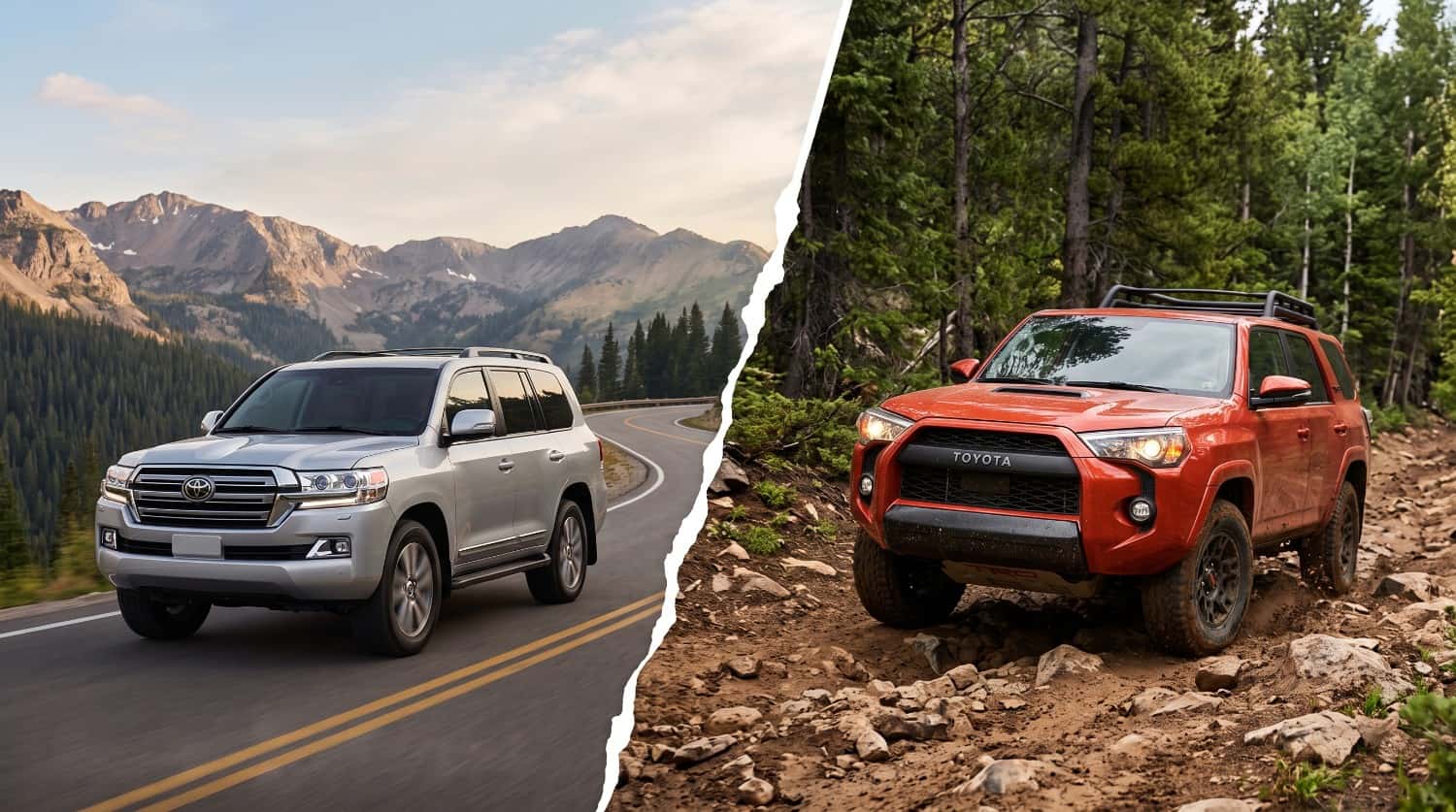
Quick Summary: In the showdown between the Land Cruiser vs 4Runner, your choice boils down to upscale overlanding poise versus raw, customizable trail utility. The reborn Toyota Land Cruiser comes exclusively as a premium five-passenger hybrid packed with standard full-time 4WD and heritage-inspired luxury. The sixth-generation 4Runner offers a broader lineup, available three-row seating, and aggressive trail trims like the TRD Pro at a lower starting price point. Both share high-strength truck bones, but the Land Cruiser prioritizes refined all-weather touring while the 4Runner focuses on rugged adventure value.
Walk onto our lot at James Hodge Toyota, and you will immediately notice customers pacing back and forth between two distinct corners of the showroom. On one side sits the chiseled, retro-cool front end of the all-new Land Cruiser. A few rows over rests the aggressive, flared posture of the redesigned 4Runner.
Choosing between the Land Cruiser vs 4Runner used to be simple when tens of thousands of dollars separated them. Today, they share Toyota’s ultra-rigid TNGA-F truck platform, modern turbocharged power, and serious trail heritage. That shared foundation creates the best kind of buyer headache: two genuine off-roaders built to outlast your loan.
Yet they deliver two entirely different daily driving experiences. One is a calm, upscale cruiser tuned for long-distance highway comfort and quiet confidence when pavement turns to dirt. The other is a high-energy Swiss Army knife with an accessible price tag, a roll-down rear window, and a trim lineup tailored to every lifestyle.
If you are stuck choosing which keys to take home, you are not alone. Let’s break down the real trade-offs so you can decide which rig belongs in your driveway.
Key Takeaways
- Price gap: Expect roughly a $16,000 spread between base entry trims, though high-tier 4Runner trims like Trailhunter creep right into base Land Cruiser territory.
- Off-road capability: Land Cruiser equips every trim with full-time four-wheel drive and a locking center differential; 4Runner leans heavily into aggressive, crawl-ready hardware with selectable part-time or full-time systems.
- Towing muscle: Both vehicles share a stout 6,000-pound maximum towing capacity when equipped with the turbocharged hybrid powertrain.
- Luxury factor: The Land Cruiser delivers a whisper-quiet, premium cabin built for high-mileage road trips, while the 4Runner emphasizes easy-to-clean durability and trail tech.
- Everyday livability: Only the 4Runner offers an optional third row and that iconic roll-down power rear glass; Land Cruiser sticks strictly to a two-row, five-passenger layout.
Toyota Land Cruiser vs 4Runner at a Glance
| Feature | Toyota Land Cruiser | Toyota 4Runner |
| Segment | Midsize Premium Adventure SUV | Midsize Rugged Trail & Utility SUV |
| Standard Engine | i-FORCE MAX 2.4L Turbo Hybrid | i-FORCE 2.4L Turbo 4-Cylinder |
| Available Engine | Standard Hybrid Only | i-FORCE MAX 2.4L Turbo Hybrid |
| Horsepower / Torque | 326 hp / 465 lb-ft | 278 hp / 317 lb-ft (Standard)
326 hp / 465 lb-ft (Hybrid) |
| Fuel Economy (EPA Est.) | 22 mpg city / 25 mpg hwy / 23 combined | Up to 20 mpg city / 26 mpg hwy (Standard)
~22 mpg combined (Hybrid) |
| Starting MSRP | ~$56,000 | ~$40,000 |
| Max Towing Capacity | 6,000 lbs | 6,000 lbs |
| Ideal Buyer | Drivers who crave vintage styling, quiet long-haul luxury, and effortless standard full-time 4WD. | Adventure seekers wanting maximum trail trim variety, available 3rd row, or high-value capability. |
What’s the Real Difference Between the Land Cruiser and 4Runner
Think of the Land Cruiser as Toyota’s flagship global diplomat. For seven decades, the badge has stood for unbreakable reliability, timeless design, and go-anywhere calm. This new generation leans hard into that legacy with boxy, vintage proportions, squared-off mirrors, and an understated, high-end cabin. It’s engineered for someone who wants to cross continents in total comfort without screaming for attention at the trailhead.
The 4Runner, meanwhile, is the rugged North American workhorse built for dirt, dust, and camping gear. Where the Land Cruiser favors restrained retro styling, the 4Runner flexes aggressive fender flares, sharp angles, and an unapologetically athletic stance. It remains the customizable Swiss Army knife of the trail community ready to take a beating on rocky passes, haul mountain bikes, and look right at home covered in mud on Monday morning.
Land Cruiser vs 4Runner Size and Dimensions
| Dimension | Toyota Land Cruiser | Toyota 4Runner |
| Overall Length | 193.8 in | 194.9 in |
| Overall Width | 77.9 in | 77.9 in (up to 79.5 in on TRD Pro / Trailhunter) |
| Overall Height | 75.7 – 76.1 in | 72.6 – 74 in |
| Wheelbase | 112.2 in | 112.2 in |
| Ground Clearance | 8.7 in | 8.2 in – 9.2 in (trim dependent) |
Because both rigs share the same 112.2-inch wheelbase and general footprint, they take up virtually identical real estate in a standard two-car garage. You won’t struggle to park one more than the other around town.
The real difference shows up on the trail and at the roofline: the Land Cruiser sits taller with a standard flat roof and consistent 8.7 inches of ground clearance, giving you exceptional upright visibility. The 4Runner is an inch longer overall, features a slightly sleeker cabin profile, and offers up to 9.2 inches of trail clearance on dedicated off-road trims like the TRD Pro.
Land Cruiser vs 4Runner Interior and Cargo Space
| Feature | Toyota Land Cruiser | Toyota 4Runner |
| Seating Capacity | 5 passengers (2 rows only) | 5 passengers standard; up to 7 with available 3rd row |
| Cargo Volume (Behind 2nd Row) | 37.5 cu ft | 48.4 cu ft (Standard Gas) / 42.6 cu ft (Hybrid) |
| Max Cargo Volume (Seats Folded) | Up to 82.0 cu ft | 90.2 cu ft (Standard Gas) / 82.6 cu ft (Hybrid) |
| Interior Materials | Durable heritage cloth, SofTex, or supple perforated leather | Tough utilitarian cloth, SofTex, or premium semi-aniline leather |
| Infotainment & Tech | 8.0-inch or available 12.3-inch screen, Head-Up Display, 14-speaker JBL audio | 8.0-inch or available 14.0-inch screen, digital gauge cluster, 14-speaker JBL audio |
Open the doors at James Hodge Toyota, and the interior philosophy hits you right away. The Land Cruiser’s cockpit feels tailored and serene. You get thick-rimmed switchgear, upright sightlines, and plush padding everywhere your elbows rest. It’s built for seven-hour interstate stretches where you want to arrive at camp completely fatigue-free.
The 4Runner takes a sportier, high-utility angle. Its controls are chunkier and designed to be grabbed with work gloves, while the available 14-inch center display dwarfs the Land Cruiser’s screen. If you have kids or run school carpools, the 4Runner’s optional third row gives it an undeniable edge for family duty.
Packing for a week-long gear haul reveals another key difference. Because every Land Cruiser carries a standard hybrid battery beneath the floor, its load deck sits slightly raised. Gas-powered two-row 4Runner models give you a deeper floor with over 90 cubic feet of maximum cargo room.
Daily errands also favor the 4Runner’s signature power rear window; you can drop groceries or dog leashes into the trunk without opening the liftgate. But if sheer acoustic insulation and premium finish matter more than extra cubic inches, the Land Cruiser wins on every daily commute.
Land Cruiser vs 4Runner Horsepower and MPG
| Specification | Toyota Land Cruiser | Toyota 4Runner (Standard Gas) | Toyota 4Runner (i-FORCE MAX) |
| Powertrain | 2.4L Turbo 4-Cylinder Hybrid | 2.4L Turbocharged 4-Cylinder | 2.4L Turbo 4-Cylinder Hybrid |
| Horsepower | 326 hp @ 6,000 rpm | 278 hp @ 6,000 rpm | 326 hp @ 6,000 rpm |
| Torque | 465 lb-ft @ 1,700 rpm | 317 lb-ft @ 1,700 rpm | 465 lb-ft @ 1,700 rpm |
| Transmission | 8-speed automatic | 8-speed automatic | 8-speed automatic |
| EPA Fuel Economy (City/Hwy/Comb.) | 22 / 25 / 23 mpg | Up to 20 / 26 / 22 mpg (2WD)
19 / 25 / 21 mpg (4WD) |
23 / 24 / 23 mpg |
| Fuel Tank Capacity | 17.9 gal | 19.0 gal | 19.0 gal |
Pop the hood on both, and you will spot a familiar setup. Toyota ditched the thirsty naturally aspirated V6 and V8 engines of the past for efficient, high-boost four-cylinder engineering. The result is an instant, low-end punch where it actually counts.
Step on the pedal from a dead stop, and the difference between gas and hybrid becomes obvious within ten feet. Standard 4Runner models deliver snappy, dependable acceleration, but they have to rev higher to hit their stride. The Land Cruiser along with hybrid 4Runner trims uses an electric motor tucked inside the transmission to shove you forward instantly with 465 lb-ft of low-end torque.
That electric assist completely changes your daily commute in stop-and-go traffic. You get smooth, silent off-the-line pull without the engine screaming or hunting through gears. It makes merging into tight highway traffic effortless.
At an 80-mph interstate cruise, both rigs settle down nicely, but the Land Cruiser feels noticeably more composed. Its standard full-time four-wheel drive and acoustic glass keep the cabin serene, whereas the 4Runner lets in a touch more engine growl when you ask for passing power. Whichever you drive home from James Hodge Toyota, 23 combined mpg means you will spend far less time parked at the gas pump.
Land Cruiser vs 4Runner Off-Road Capability
| Capability Spec | Toyota Land Cruiser | Toyota 4Runner (TRD Off-Road / Pro / Trailhunter) |
| 4WD System | Standard Full-Time 4WD with 2-speed transfer case | Part-Time 4WD (SR5, TRD) or Full-Time 4WD (Limited, Platinum) |
| Locking Differentials | Standard Center & Rear Electronic Locking Differentials | Electronic Rear Locking Differential (Standard Center on Full-Time 4WD) |
| Sway Bar Disconnect | Available Front Stabilizer Disconnect Mechanism (SDM) | Available Front Stabilizer Disconnect Mechanism (SDM) |
| Off-Road Software | Multi-Terrain Select (MTS), CRAWL Control, Downhill Assist | Multi-Terrain Select (MTS), CRAWL Control, Downhill Assist |
| Approach / Departure Angle | 31.0° / 22.0° | Up to 33.0° / 24.0° (TRD Pro / Trailhunter) |
| Ground Clearance | 8.7 in | Up to 10.1 in (TRD Pro / Trailhunter) |
On paper, both machines share the exact same high-tech trail wizardry. Both offer Toyota’s smart push-button sway bar disconnect to keep your tires planted over uneven boulders. Both feature CRAWL Control, essentially low-speed off-road cruise control along with multi-terrain camera views that spot hidden obstacles before your tires touch them.
Yet out on technical trails, the dedicated 4Runner trims edge out as the more specialized rock crawlers. Models like the TRD Pro and Trailhunter come straight from the factory wearing 33-inch all-terrain tires, Old Man Emu or FOX internal bypass shocks, high-clearance bumpers, and a massive 10.1 inches of obstacle clearance. It’s built for rugged boulder crawling, trail rash, and aggressive backcountry exploration.
The Land Cruiser takes a very different, highly capable approach to the wild. It comes standard on every trim with full-time four-wheel drive, meaning you never have to guess whether you need to shift into 4WD on icy asphalt, washboard dirt, or unexpected mud. Combined with its center and rear locking differentials, it tackles technical overlanding routes with relaxed poise.
If you want an extreme weekend warrior ready for muddy trails straight off the showroom floor, take the 4Runner. If you want a serene, all-weather explorer that balances deep trail prowess with five-star highway composure, the Land Cruiser is your answer.
Land Cruiser vs 4Runner Towing Capacity
| Metric | Toyota Land Cruiser | Toyota 4Runner (Standard Gas) | Toyota 4Runner (i-FORCE MAX) |
| Max Towing Capacity | 6,000 lbs | 6,000 lbs | 6,000 lbs |
| Standard Hitch | Class IV Receiver & Wiring | Class IV Receiver & Wiring | Class IV Receiver & Wiring |
| Trailer Sway Control | Standard | Standard | Standard |
A 6,000-pound ceiling across both models hits the sweet spot for weekend toys. You have plenty of muscle to haul a pair of jet skis, a 20-foot ski boat, or a loaded dual-axle camper without breaking a sweat. Because both rigs ride on the same boxed truck frame, they stay remarkably planted on steep highway grades. The Land Cruiser’s standard full-time four-wheel drive gives it an extra edge of traction when pulling heavy trailers up wet boat ramps.
Land Cruiser vs 4Runner Price
| Trim Level | Starting MSRP (Est.) | Standard Drivetrain & Powertrain |
| 4Runner SR5 | $41,800 | 2.4L Turbo Gas / RWD (Part-Time 4WD available) |
| 4Runner TRD Off-Road | $50,200 | 2.4L Turbo Gas / Part-Time 4WD |
| Land Cruiser 1958 | $56,700 | 2.4L Turbo Hybrid / Full-Time 4WD |
| 4Runner Limited (Hybrid) | $61,000 | 2.4L Turbo Hybrid / Full-Time 4WD |
| Land Cruiser (Base/Mid) | $62,500 | 2.4L Turbo Hybrid / Full-Time 4WD |
| 4Runner TRD Pro / Trailhunter | $68,000 | 2.4L Turbo Hybrid / Part-Time 4WD |
That starting price gap looks wide at first glance, but it narrows quickly once you line up equipment. A base 4Runner SR5 lets you get into a brand-new, rugged midsize SUV for around $42,000. However, once you add the i-FORCE MAX hybrid powertrain and premium trail hardware to a 4Runner, you are suddenly knocking on the Land Cruiser’s door.
The extra money for a Land Cruiser buys you refined engineering from mile one. You are paying for standard hybrid torque, seamless full-time four-wheel drive, superior acoustic dampening, and that unmistakable heritage badge. If you want specialized high-speed desert shocks or an overland snorkel, the top-tier 4Runner trims earn their keep. But for overall quiet comfort and all-weather composure per dollar, the Land Cruiser makes a compelling case.
Land Cruiser vs 4Runner Warranty and Maintenance: What’s Covered?
One question our service advisors hear constantly at Hodge Toyota is: “How expensive is it going to be to maintain that hybrid setup?”
The short answer: Toyota protects your wallet on both fronts right out of the gate. Here is exactly how the factory coverage and ongoing upkeep break down:
- Basic limited bumper-to-bumper warranty: Both vehicles include 3 years or 36,000 miles of comprehensive coverage, protecting you against unexpected component defects early in your ownership.
- Powertrain protection: The engine, transmission, and drivetrain components are covered for 5 years or 60,000 miles on both the Land Cruiser and the 4Runner.
- Hybrid battery and system coverage: The standard hybrid system on the Land Cruiser and the available i-FORCE MAX hybrid on the 4Runner carry a 10-year or 150,000-mile battery warranty, alongside an 8-year or 100,000-mile hybrid system warranty.
- Complimentary factory scheduled maintenance: ToyotaCare comes standard on both rigs, delivering 2 years or 25,000 miles of zero-cost routine synthetic oil changes, tire rotations, fluid top-offs, and multi-point inspections.
- 24/7 Roadside assistance: Enjoy 2 full years of unlimited-mile roadside protection, covering everything from flat-tire changes to emergency tows.
Day-to-day maintenance routines look virtually identical across both SUVs. Routine wear intervals for brake pads, cabin filters, and fluids track the exact same schedule under normal highway driving.
The only practical upkeep difference comes down to trim choices. If you choose an extreme 4Runner model equipped with specialized Old Man Emu or FOX internal bypass shocks and heavy trail armor, you will want to schedule periodic inspections after hardcore trail runs to keep that hardware trail-ready.
Land Cruiser vs 4Runner Features: What You Actually Notice Day to Day
When we put customers in both models back to back on our lot, the first thing they usually comment on is the cockpit view. The Land Cruiser features low, flat window sills and a deeply recessed cowl, giving you an almost panoramic look over the hood. Drivers tell us it feels instantly approachable to park despite its blocky shoulders. In the 4Runner, you sit slightly lower within a sportier, cocoon-like dash that feels more like a dedicated trail rig.
On the road, the daily differences emerge in the details. Both rigs come equipped with Toyota Safety Sense 3.0, packing full-speed adaptive cruise control, lane tracing, and proactive driving assist. But customers immediately notice cabin noise levels. The Land Cruiser’s acoustic laminated windshield and extra firewall insulation soak up highway drone effortlessly. Close the doors, and the outside world drops away.
Screen real estate is another hot debate during test drives. Buyers drawn to cutting-edge tech love the 4Runner’s available 14-inch touchscreen; it’s massive, bright, and dominates the cabin. The Land Cruiser tops out with a 12.3-inch display, but it counters with a cleaner layout and physical toggle switches for climate and trail controls that feel machined and substantial.
Then there are the signature lifestyle touches. Pet owners almost always fall in love with the 4Runner’s roll-down tailgate window, dogs stick their noses out, and long 2x4s slide right in. Land Cruiser shoppers, on the other hand, gravitate toward the chilled center-console cool box and the classic upright seating that keeps lower backs fresh on five-hour highway runs.
Which One Should You Buy
Choose the 4Runner If:
- You want maximum capability for your budget: With entry SR5 trims starting well below the Land Cruiser, you can get into a genuine body-on-frame trail vehicle without stretching your monthly payment.
- You need an available third row for family duty: If carpooling kids or accommodating extra friends on weekend trips is part of your regular routine, the 4Runner is the only one of the two offering that flexible third-row layout.
- You love the open-air utility of the power rear window: That signature roll-down back glass makes loading groceries, hauling oversized gear, and giving your dog fresh air completely effortless.
- You want purpose-built factory off-road hardware: Trims like the TRD Pro and Trailhunter come straight off the lot equipped with 33-inch tires, snorkel-style air intakes, and rock-ready bypass shocks designed for punishing trails.
Choose the Land Cruiser If:
- You demand effortless, all-weather stability: Every single Land Cruiser includes full-time four-wheel drive as standard equipment, giving you confidence in rain, snow, or mud without ever touching a transfer case dial.
- You value a quiet, fatigue-free highway ride: With acoustic glass, premium firewall sound dampening, and supple seating, it turns seven-hour interstate hauls into peaceful, stress-free road trips.
- You want hybrid torque and heritage styling baked in: From the vintage round-headlight 1958 trim to the chiseled modern boxy silhouette, you get head-turning presence backed by a punchy 465 lb-ft of hybrid torque.
- You prefer refined luxury over raw utility: If plush leather, machined switchgear, a console cool box, and understated global prestige matter more to you than extra plastic trail armor, the flagship experience delivers every mile.
Test Drive Both at James Hodge Toyota
Reading spec charts and comparing dimensions online will only get you halfway to an answer. Nothing clarifies the difference quite like climbing into the driver’s seat, testing the sightlines over each hood, and feeling how both powertrains deliver torque on the pavement.
Our team at James Hodge Toyota walks customers through this exact decision every single week. We know the right choice usually comes down to your personal travel routines, garage space, and how you spend your weekends. Whether you want to test the acoustic silence of the Land Cruiser or see how a stroller fits into the back of a 4Runner, we are here to set up side-by-side test drives and give you straightforward answers without any pressure.
Conclusion
Choosing between the Land Cruiser vs 4Runner is not a matter of picking a winner it is about matching an iconic SUV to your lifestyle. The 4Runner shines as an adaptable, high-energy trail machine delivering unbeatable value, aggressive trim options, and practical everyday touches like that roll-down rear glass. The Land Cruiser stands apart as a refined, retro-styled flagship that balances genuine overlanding capability with whisper-quiet highway luxury and effortless standard full-time four-wheel drive.
Ready to feel the difference for yourself? Stop byJames Hodge Toyota today, take both for a spin, and drive home the Toyota SUV that fits your next adventure.
Frequently Asked Questions
Is the Land Cruiser bigger than the 4Runner?
No, both share the exact same 112.2-inch wheelbase and general footprint. The 4Runner is actually about an inch longer bumper-to-bumper, while the Land Cruiser sits roughly two inches taller due to its upright, squared-off roofline.
Which is better off-road, the Land Cruiser or 4Runner?
Both conquer rough terrain easily, but dedicated 4Runner trims like the TRD Pro and Trailhunter have an edge in extreme rock crawling thanks to factory 33-inch tires and up to 10.1 inches of ground clearance. The Land Cruiser excels in seamless overlanding and bad-weather driving with standard full-time 4WD and dual locking differentials.
How much more expensive is the Land Cruiser than the 4Runner?
The entry-level price gap is around $15,000 to $16,000 between a base 4Runner SR5 and a base Land Cruiser 1958. However, top-tier hybrid 4Runner trims like the TRD Pro or Trailhunter close that gap entirely and sell for nearly identical prices as a mid-tier Land Cruiser.
Which has better towing capacity, Land Cruiser or 4Runner?
They are completely tied. Both the Land Cruiser and properly equipped hybrid or gas 4Runner models offer a maximum towing capacity of 6,000 pounds, which is plenty for light campers, utility trailers, and midsize boats.
What is the fuel economy difference between the Land Cruiser and 4Runner?
Fuel economy is virtually identical when comparing hybrid powertrains, with both earning around 23 mpg combined. Non-hybrid gas 4Runner models average around 21 to 22 mpg combined, giving the standard hybrid system in the Land Cruiser a slight edge in city stop-and-go efficiency.
Does the Land Cruiser have more cargo space than the 4Runner?
No, the two-row gas 4Runner holds more cargo with up to 90.2 cubic feet of maximum room. Because the Land Cruiser carries a standard hybrid battery beneath the floor, its load deck is raised slightly, providing 37.5 cubic feet behind the second row and 82.0 cubic feet with seats folded.
Which Toyota SUV is better for daily driving?
If you prioritize quiet cabin acoustics, a supple highway ride, and all-weather confidence without touching a 4WD dial, the Land Cruiser is the superior daily commuter. If you have kids who need an available third row or you frequently haul gear using a roll-down rear window, the 4Runner is tough to beat.
0 comment(s) so far on Land Cruiser vs 4Runner: Which Toyota SUV Fits Your Garage?