

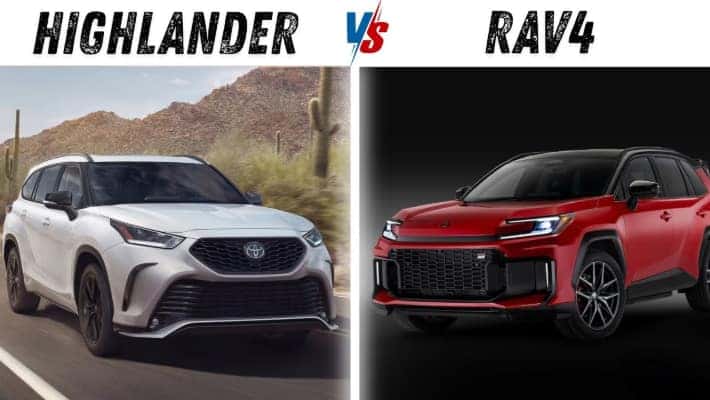
Toyota Highlander vs RAV4: Which SUV Actually Fits Your Family?
Key Takeaways
- The RAV4 and Highlander serve genuinely different family sizes and seating needs; your decision should be driven first.
- The Highlander offers an available third row; the RAV4 does not in any trim
- RAV4 generally gets better fuel economy (up to 41 MPG city in Hybrid trim)
- Highlander is longer, wider, and heavier, worth knowing if you’re navigating tighter Oklahoma roads
- Both hold their value well, but the RAV4 carries a lower entry price point
- If you’re regularly hauling five or more people, the Highlander comparison deserves a closer look
Most people come into this comparison already leaning one way. They’ve seen both in parking lots. They know someone who drives one. They’ve done enough scrolling to feel like they almost have an answer, they just want someone to confirm it.
That’s actually fine. The Toyota Highlander vs RAV4 question isn’t complicated once you strip away the spec-sheet noise. Both are genuinely good vehicles. Both are Toyotas, which already means you’re starting with reliability, decent resale value, and a dealer network that isn’t going anywhere. The question isn’t which one is better in some abstract sense. It’s which one is better for your actual life.
At JamesHodge Toyota in Muskogee, this conversation comes up constantly. Families comparing cargo space. Parents are counting car seat configurations. Drivers are thinking about fuel costs on longer Oklahoma commutes. The answers usually point in pretty clear directions, and that’s what this is about.
Two Great Toyota SUVs, but They’re Not Interchangeable
People walk into Hodge Toyota asking this question constantly. RAV4 or Highlander? And honestly, it’s one of the better questions a car shopper can ask, because it means they’ve already done some homework. They know both models have serious reputations. They’re not starting from scratch.
But here’s the thing: a lot of online comparisons treat this like a coin flip. It isn’t.
The RAV4 and Highlander aren’t competing for the same buyer. They’re solving different problems. One family’s perfect SUV is another family’s wrong answer entirely. So instead of declaring a winner, let’s talk about what actually matters when you’re the one making payments and loading gear on a Saturday morning in Muskogee.
RAV4 vs Highlander Size: How Different Are They Really?
More than most people expect.
The RAV4 is a compact SUV. The Highlander is a midsize. That distinction sounds like car industry jargon, but it plays out in real life every single time you park, load groceries, or try to squeeze three car seats into the back row.
| Spec | RAV4 | Highlander |
| Length | 180 inches | 194 inches |
| Width | 73 inches | 76 inches |
| Cargo (behind rear seats) | 37.6 cu ft | 16.0 cu ft |
| Max cargo (all seats down) | 69.8 cu ft | 84.3 cu ft |
| Rows of seating | 2 rows / 5 seats | 3 rows / 7–8 seats |
The Highlander is a noticeably bigger vehicle, roughly a foot longer and meaningfully wider. For some families, that extra room is the whole point. For others, especially those navigating older neighborhoods or tighter parking situations, the RAV4’s footprint is actually an advantage.
Cargo is worth thinking through carefully. The Highlander technically holds more total cargo, but with all seats occupied, you’re left with very little behind that third row. About sixteen cubic feet, roughly the size of a large carry-on suitcase. If you’re going anywhere with three rows of people and bags, you may be strapping things to the roof.
The RAV4, without a third row, gives you solid usable cargo space on every trip.
RAV4 vs Highlander Third Row: The Deciding Factor for Most Families
This is where the comparison actually forks.
The Highlander offers a third row. The RAV4 doesn’t, period, in any trim level.
If your household genuinely needs to seat seven or eight people on a regular basis, the Highlander earns serious consideration just on that basis alone. Carpooling kids to baseball practice, road trips with extended family, picking up in-laws from Tulsa that third row can be legitimately useful.
But. The Highlander’s third row is best for smaller passengers. Teenagers and adults will notice the tighter legroom back there, and anyone who’s ever climbed in or out of a third-row seat knows it’s not exactly graceful. It works. It’s just not luxurious.
If your family is mostly four to five people, the RAV4’s second row is genuinely comfortable, and you’re not paying for space you’ll rarely use. That matters.
RAV4 vs Highlander MPG: The Numbers That Actually Matter
| Spec | RAV4 | Highlander |
| Gas City | 27 MPG | 21 MPG |
| Gas Highway | 35 MPG | 29 MPG |
| Hybrid City | 41 MPG | 36 MPG |
| Hybrid Highway | 38 MPG | 35 MPG |
| RAV4 Prime (PHEV) | 38 MPG + EV range | N/A |
If fuel economy is a priority, and with Oklahoma highway driving and gas prices being what they are, it probably should be the RAV4 has a real edge here. The RAV4 Hybrid is remarkably efficient for its size and capability. Lots of local families running Muskogee errands and longer stretches toward the Tulsa metro have been pleasantly surprised by how little they’re stopping for gas.
The Highlander Hybrid still delivers decent numbers for a three-row midsize. You’re not going to feel punished at the pump. But if maximum efficiency matters to you, the RAV4 is the cleaner pick.
RAV4 MPG Advantages
- Better city fuel economy
- Lower fuel costs over time
- Excellent hybrid efficiency
Highlander MPG Advantages
- Better comfort for larger families
- Strong efficiency for a midsize SUV
- Hybrid option still performs well
Trim Levels and Value: Which Toyota SUV Gives You More for the Money?
Pricing is a real consideration, and the gap between these two vehicles isn’t small.
| Spec | RAV4 | Highlander |
| Starting MSRP | $29,800 – $31,195 | $40,300 – $41,800 |
| Popular mid-trim (XLE) | $32,000–$36,000 | $42,000–$46,000 |
| Hybrid premium | Moderate | Moderate |
| Resale value | Excellent | Excellent |
Both models offer strong resale value. Toyota’s reputation for reliability holds up here; used RAV4s and Highlanders hold their value notably well compared to competing brands. That matters when you’re thinking about a trade-in three to five years down the road.
For families who don’t genuinely need three rows, spending more for seats they’ll rarely use is worth questioning. The RAV4 delivers most of the same ownership experience at a meaningfully lower price.
Driving Feel and Day-to-Day Ownership
Here’s something the spec sheets don’t tell you.
The RAV4 feels more car-like to drive. It’s nimble, easy to park, and doesn’t feel like you’re piloting a big vehicle, even though it’s genuinely capable. Oklahoma roads can be unpredictable, with potholes, sudden weather, and stretches of construction, and the RAV4 handles everyday driving without requiring much thought.
The Highlander has a more planted, composed highway ride. It’s smoother at higher speeds and feels more premium in the way bigger vehicles often do. If you’re doing a lot of highway miles, that extra size pays off in comfort.
Both have strong safety ratings and come standard with Toyota Safety Sense, automatic emergency braking, lane departure warning, adaptive cruise control, and more.
Why Buyers Choose the RAV4
- Easier parking
- Lower ownership cost
- Better commuting SUV
- Excellent fuel economy
Why Buyers Choose the Highlander
- More passenger space
- Third-row seating
- Better road-trip comfort
- More cargo flexibility
What Most Online Toyota SUV Comparisons Miss
A lot of comparison articles focus almost entirely on specifications. Length, horsepower, MPG, cargo numbers. Useful information, sure. But that’s rarely what ownership comes down to after six months.
The real difference between the Toyota Highlander and RAV4 usually shows up in daily routines.
The RAV4 tends to feel easier during normal life: parking lots, commuting, quick errands, tighter spaces around town. The Highlander starts making more sense once road trips, carpools, multiple kids, or regular passenger hauling become part of the equation.
That distinction matters more than most spec sheets do.
Understanding Local Needs: Muskogee Families and Oklahoma Driving Conditions
SUV shopping looks different in Oklahoma than it does in bigger cities.
A lot of families around Muskogee are balancing daily commuting with weekend travel, school activities, sports gear, and longer highway drives toward Tulsa or Oklahoma City. That’s partly why both the RAV4 and Highlander make sense here they just solve different problems.
Drivers spending most of their time commuting or running errands around town often lean toward the RAV4 Hybrid. It’s easier to maneuver, easier on fuel, and honestly less stressful in tighter parking situations.
The Highlander tends to make more sense for growing families. Especially if road trips, carpools, or hauling extra passengers happen regularly. That additional room starts becoming valuable pretty quickly once kids, bags, coolers, and sports equipment all enter the picture at the same time.
At Hodge Toyota, a lot of buyers end up deciding after driving both back-to-back. Sometimes the RAV4 immediately feels more practical. Sometimes families sit inside the Highlander and realize the extra space is absolutely worth it.
That’s usually when the decision becomes much easier.
So Which One Is Actually Right for Your Family?
Here’s the honest answer: it depends on one question first. Do you need a third row?
If yes, look at the Highlander. Do the math on trim levels, think about whether you’ll actually use that third row weekly or just a few times a year, and decide accordingly.
If not, the RAV4 is a hard vehicle to argue against. It’s efficient, reliable, well-priced, practical, and genuinely fun to drive relative to its class. It does what most families actually need, without the bulk or cost of a midsize SUV.
Neither choice is wrong. They’re just different answers to different problems.
Frequently Asked Questions
Q: Does the RAV4 have a third row?
A: No. The RAV4 is a two-row SUV with seating for five. If you need a third row from Toyota, the Highlander is the next step up.
Q: Which gets better fuel economy, RAV4 or Highlander?
A: The RAV4, particularly in Hybrid trim, gets significantly better fuel economy. RAV4 Hybrid achieves up to 41 MPG city compared to around 36 MPG city for the Highlander Hybrid.
Q: Is the Highlander worth the extra cost over the RAV4?
A: If you genuinely need three-row seating or prefer a larger, more highway-oriented SUV, yes. If your family is five people or fewer and efficiency matters, the RAV4 delivers most of the same value at a lower price.
Q: How do they compare for towing?
A: The 2025 Highlander can tow up to 5,000 lbs with its 2.4L turbocharged 4-cylinder engine. The RAV4 tops out around 3,500 lbs (on Adventure or TRD Off-Road trims). If towing a boat or trailer is part of your regular life, the Highlander has a clear structural advantage.
Q: Which holds its resale value better?
A: Both are excellent. RAV4s tend to be in higher demand due to sheer sales volume, which supports strong resale. Highlander Hybrid trims also hold value particularly well.
Q: Can I test drive both at James Hodge Toyota in Muskogee?
A: Yes, James Hodge Toyota carries both models and can arrange same-day drives on each so you can compare them directly.
0 comment(s) so far on Toyota Highlander vs RAV4: Which SUV Actually Fits Your Family?